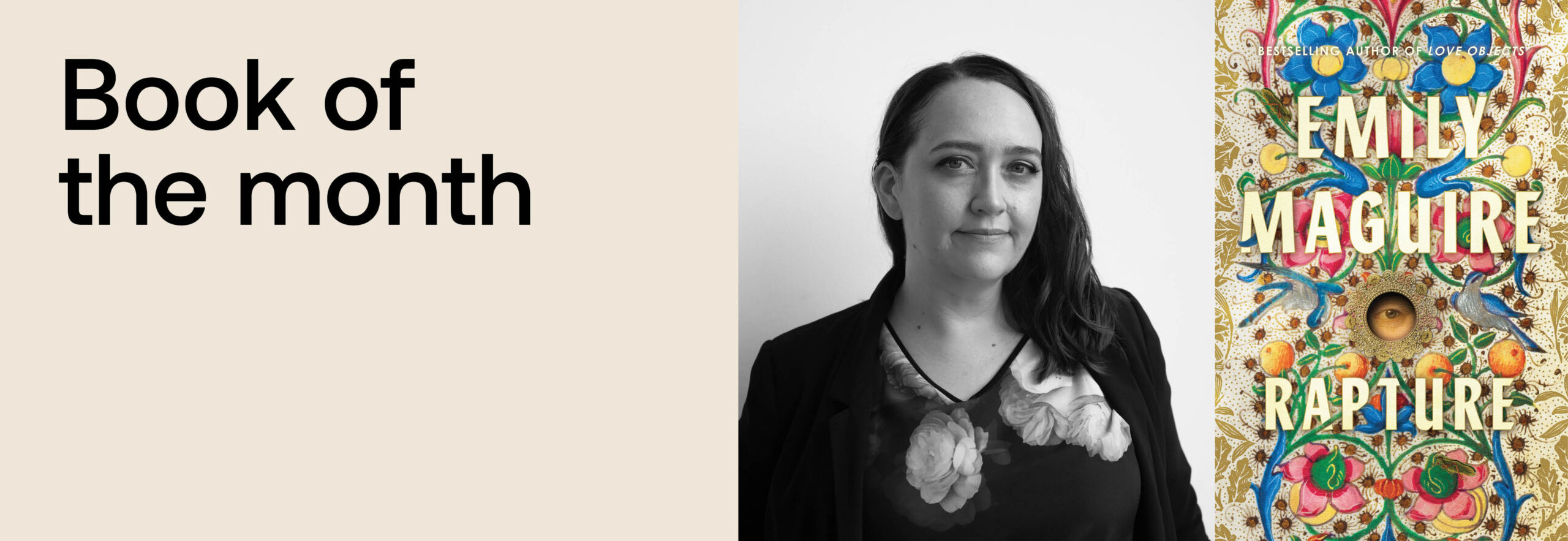

This month Stella celebrates Rapture, longlisted for the 2025 Stella Prize. 

We sat down with Emily to discuss character building in historical settings, and the monumental task of researching her novel.

What are you reading at the moment?

I’ve just finished reading an early copy of Mirandi Riwoe’s A Short History of Longans (out in July) which is exquisite, and I’m now deeply invested in Lily King’s Heart the Lover.

Do you remember how you felt when you found out youd been longlisted for the 2025 Stella Prize?

Delighted! Having been shortlisted back in 2017 for An Isolated Incident, I knew that a Stella listing gives a book a huge boost and opens up lots of opportunities for important (and often fun!) conversations about books and writing.

Rapture reimagines the legend of Pope Joan. What made you want to write about this story? In what ways did you remain faithful to the legend, and where did you diverge?

On the surface, it’s a story about a trickster and adventurer, someone who chases an ever bigger life while hoodwinking her supposed superiors. That alone was enough to hook me. Then, as I dug deeper I saw that the legend — and the way its been told and retold over the centuries — is about all the things Ive been thinking and writing about for twenty years: identity, ambition, faith, patriarchy, sex.

I decided early on to stick to the basic trajectory of the legend in terms of event, but knew I would need to create the central character from scratch so that she would be her own woman and not a re-creation of a reproduction of a half-told story from a faded chronicle.

“Rapture stands out as a thought-provoking exploration of resilience and the possibilities contained within the female body.”

2025 Stella Prize Judges

This book is grounded by historic details of monastery routines and medieval daily life. How do you approach researching a historical novel? Did your research take you down any surprising paths, and how do you decide when the research has finished?

Digging into the research was an absolute joy. I could read about early medieval Europe forever. Two key settings were particularly fun to build up from the historical records: the monastery in Fulda, about which we have a decent amount of information, thanks to the monks themselves being the foremost chroniclers of their time and then, of course, the Lateran Palace in Rome which is still standing, although it’s use is significantly different today.

I also got deeply into the chronicles of the war that rages in the background for much of the book. In the end I had to take all this fascinating stuff and run it through the filter of my main character Agnes; if it wouldn’t have been noticed by or important to her, then it couldn’t be in the book.

 Judges Report

Emily Maguire’s novel Rapture is a big story recounting the events of its causing, in writing that is as compelling as it is superb, as it is consuming. The author’s rendering of hunger; of knowledge, of flesh, of being a woman in a time and place that is confined and limited, is outstanding. The reimagining of a contested legend of a female Pope, Rapture presents protagonist Agnes’s journey through the rigid confines of the 9th-century Church. Agnes becomes John, to pursue her passion of intellectual study in a time when dangers of such desires lurked at every juncture. Maguire’s meticulous research and precise writing immerses readers in a world where faith, gender, and ambition clash and meld and fold. The narrative’s themes of identity and spiritual experience wander in deliberate, reflective and contemplative ways that take the reader from Mainz to Rome. Rapture stands out as a thought-provoking exploration of resilience and the possibilities contained within the female body.

How do you see Agnesstory relating to the concerns of modern Feminism? What do you hope readers take away about her story of gender, agency and selfhood?

Agnes struggles against being defined — and constrained — by how others see her. This is enormously relevant still, and to all kinds of readers. So many (too many!) people still have the experience of someone looking at them and saying “You are not the right sort of person for this. This is not for you” regardless of how qualified, passionate, smart, determined etc they are. Agnes’ story is one of shucking off societal programming and listening to the still, quiet voice that knows who she is and what she’s capable of.

What is next for you? Tell us about your upcoming projects.

I’m deep in my next novel which is inspired by another medieval story I came across while researching RAPTURE. And that’s all I can say for now!

About the Book

The motherless child of an English priest living in ninth-century Mainz, Agnes is a wild and brilliant girl with a deep, visceral love of God. At eighteen, to avoid a future as a wife or nun, Agnes enlists the help of a lovesick Benedictine monk to disguise herself as a man and devote her life to the study she is denied as a woman.

So begins the life of John the Englishman: a matchless scholar and scribe of the revered Fulda monastery, then a charismatic heretic in an Athens commune and, by her middle years, a celebrated teacher in Rome. There, Agnes (as John) dazzles the Church hierarchy with her knowledge and wisdom and finds herself at the heart of political intrigue in a city where gossip is a powerful—and deadly—currency.

And when the only person who knows her identity arrives in Rome, she will risk everything to once again feel what it is to be known—and loved.

About the Author

Emily Maguire

Further Reading

Reviews

Explore the latest from Stella

This month Stella celebrates Rapture, longlisted for the 2025 Stella Prize.  We sat down with Emily to discuss character building in historical …

the hummingbird effect

This month Stella celebrates The Hummingbird Effect, longlisted for the 2024 Stella Prize.  We sat down with Kate to discuss writing historical …

This month Stella celebrates Every Version of You, longlisted for the 2023 Stella Prize.  We sat down with Grace Chan to discuss the …

Help change the story

As a not-for-profit organisation with ambitious goals, Stella relies on the generous support of donors to help fund our work.

Every donation is important to us and allows Stella to continue its role as the leading voice for gender equality and cultural change in Australian literature.

Stella is a not-for-profit organisation with DGR status. All donations of $2 or more are tax-deductible.